
Tolleson Commercial Roofing FAQ
Tolleson covers about six square miles just south of I-10, near the Loop 101 interchange, and a Union Pacific line runs through town.
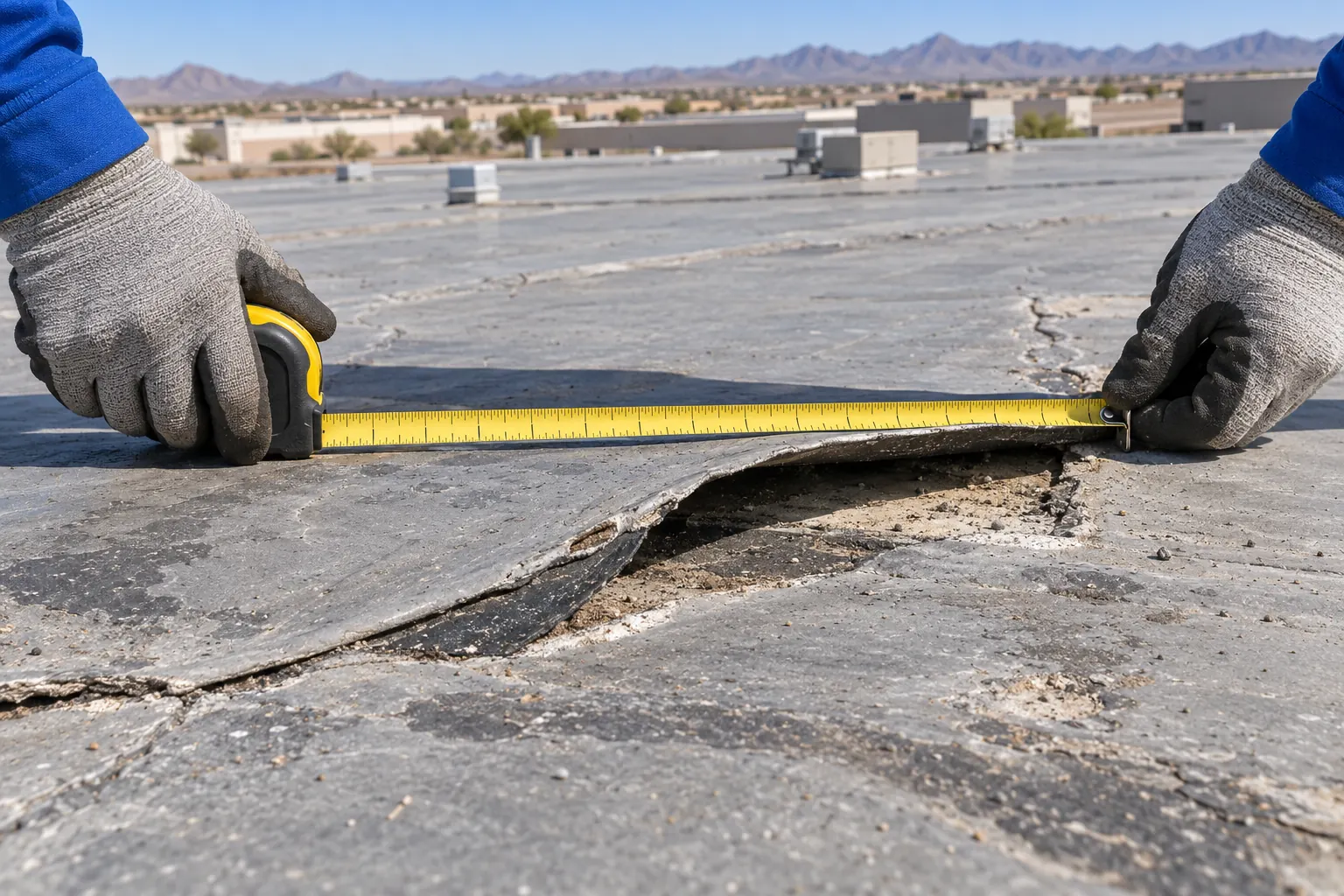
Its roofs are mostly wide, low-slope decks on food distribution centers, manufacturing plants, cold-storage buildings, and big-box retail. Those roofs take months of extreme desert sun, summer monsoon storms, and dust carried in from surrounding farmland.
Tolleson Commercial Roofing FAQ By Topic
Roof Systems
What does a commercial roofing contractor in Tolleson handle?
We install, repair, and replace low-slope and metal roofs on commercial and industrial buildings around Tolleson. That covers TPO, EPDM, and metal systems on warehouses, processing plants, retail centers, and offices.
Most jobs start with a roof inspection. Then we lay out repairs, a recover, or a full tear-off based on what the deck and insulation actually show.
Is TPO a good choice for a Tolleson warehouse roof?
Often, yes. White TPO reflects much of the sun's heat, and its welded seams handle the long, flat runs common on West Valley distribution buildings.
- Heat: A light-colored membrane can lower rooftop surface temperatures during triple-digit afternoons.
- Seams: Hot-air welding fuses the sheets into one continuous surface with no adhesive seams to dry out.
- Cold storage: Pairing TPO with thicker insulation helps buildings that hold refrigerated or frozen product.
Membrane thickness and attachment method should match roof traffic and the deck below.
When does an EPDM roof make sense in the West Valley?
EPDM fits buildings that need a flexible, forgiving membrane, such as older roofs with lots of penetrations or decks that move with temperature swings. It's a synthetic rubber sheet with a long track record on low-slope commercial roofs.
Standard EPDM is black and absorbs heat. In Tolleson's climate, ask about white EPDM or a reflective coating over it. Seams are taped or glued, so detailing around curbs and drains matters more than with welded systems.
Do you work as an industrial roofing contractor for plants and distribution centers?
Yes. Industrial roofs near the I-10 and Loop 101 corridor often cover hundreds of thousands of square feet, with exhaust fans, process equipment, and skylights spread across the field.
Those roofs call for:
- Phased work zones so production and shipping keep running
- Walkway pads around equipment that crews service often
- Coordination with safety managers on lockout, fall protection, and food-safety rules
- Detailing around vents that discharge heat, steam, or grease
Can you install or repair commercial metal roofs around Tolleson?
Yes. We work on standing-seam and through-fastened metal roofs found on shop buildings, older ag-related structures, and newer pre-engineered warehouses.
Common desert problems on metal include loose or backed-out fasteners, failed sealant at laps, and rust where coatings have worn off. Options range from refastening and resealing to a coating system or a full panel replacement. Retrofit framing can also convert a leaking flat roof to metal.
Which roof system fits which kind of building?
The right system depends on roof slope, deck type, what's inside the building, and how long you plan to own it.
| Building type | Common fit | Why it's chosen |
|---|---|---|
| Large distribution warehouse | TPO, mechanically attached | Reflective, fast to install over large areas |
| Cold storage or food processing | TPO or PVC over thick insulation | Holds interior temperatures; handles some greasy exhaust (PVC) |
| Older building with many penetrations | EPDM | Flexible and simple to patch |
| Shop, hangar, or pre-engineered building | Standing-seam metal | Long service life on sloped roofs |
| Retail strip or office | TPO or a coating over a sound existing roof | Lower disruption to tenants |
An inspection confirms whether the deck, insulation, and drainage support the system you prefer.
Weather, Repairs, And Work Days
How does West Valley heat affect a commercial roof?
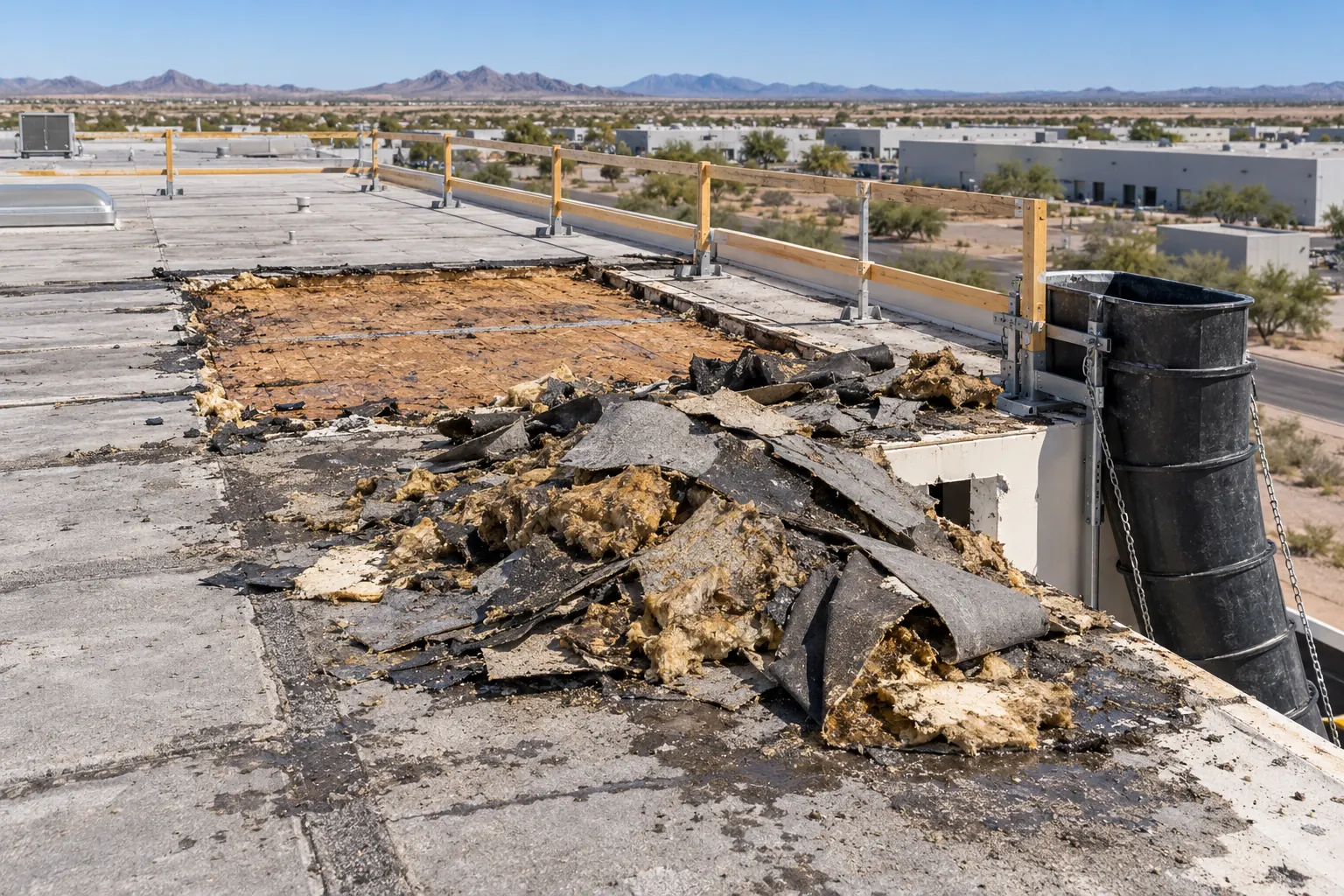
Sustained heat ages membranes, dries out sealants, and makes roofing materials expand and contract every day. Over the years that cycling opens seams, loosens flashing, and cracks older coatings.
UV exposure in the low desert is intense most of the year. Asphalt-based roofs and dark membranes lose flexibility faster here than in milder climates, which is why reflective surfaces are so common on Tolleson-area buildings.
What should building owners expect from monsoon storms?
The National Weather Service defines Arizona's monsoon season as June 15 through September 30. Storms can bring sudden downpours, strong outflow winds, blowing dust, and occasional hail.
On flat roofs, the main risks are:
- Clogged drains and scuppers from dust and debris, leading to ponding
- Wind uplift at perimeter edges and loose flashing
- Leaks at curbs, rooftop units, and old patches
Having drains cleared and edges checked before mid-June is a practical way to get ready.
Should I repair or replace my building's roof?
Repair is usually right when damage is limited and the insulation underneath stays dry. Replacement makes more sense when leaks keep coming back or wet insulation is widespread.
| Repair or restore when… | Consider replacement when… |
|---|---|
| Leaks trace to a few seams, curbs, or flashings | Leaks show up across many areas |
| A moisture scan finds mostly dry insulation | Large sections of insulation are wet |
| The membrane is still flexible | The membrane is brittle, shrinking, or split |
| The roof has years of life left | The roof is near or past its expected life |
A recover over the existing roof is sometimes allowed. Code limits the number of roof layers, so check before planning one.
Can the roof work be done while our facility stays open?
In most cases, yes. We schedule work in sections so docks, production lines, and storefronts stay in use.
- Timing: Summer crews start before sunrise to avoid peak heat and reduce noise during business hours.
- Staging: Material lifts and dumpsters go where they won't block trucks or customers.
- Dry-in: Each section is sealed watertight before crews leave for the day, especially during monsoon months.
- Odors and dust: Adhesive choice and air-intake protection are planned with your facility team, which matters inside food plants.
Question Not Answered Here?
Every roof is different under the sheet. An inspection with core cuts answers the questions this list cannot.
What To Have Ready
- Building address
- Roof type, if known
- Leak locations
- Best time for roof access
Roof Life, Upkeep, And Permits
How long do TPO, EPDM, and metal roofs last?
With good installation and upkeep, typical ranges are roughly:
| System | Typical service life |
|---|---|
| TPO | About 20–30 years |
| EPDM | About 25–30 years |
| Metal | 40 years or more |
Intense sun, foot traffic, and skipped maintenance can shorten these numbers. Membrane thickness and installation quality matter as much as the system you pick.
How often should a commercial roof be inspected and maintained?
Twice a year is a good baseline, ideally once in spring before monsoon season and once in fall after it. Get an extra check after any major storm.
A maintenance visit typically includes:
- Clearing drains, gutters, and scuppers
- Resealing open seams and loose flashing
- Looking for punctures near HVAC units and walk paths
- Noting ponding areas and coating wear
- Photographing problem spots for your records
Do I need a permit to reroof a commercial building near Tolleson?
Usually, yes. Each city's building department sets its own rules, and most treat reroofing, structural changes, and new rooftop equipment as permitted work. Estrella, Maryvale, and Laveen are urban villages inside the City of Phoenix, so Phoenix handles permits there.
| Location | Permitting authority | Where to start |
|---|---|---|
| Tolleson | City of Tolleson Building | Permits & Construction |
| Avondale | City of Avondale Development Services | Building services staff; applications go through the city's online permit portal |
| Goodyear | City of Goodyear Building Safety Division | Building Safety Division |
| Buckeye | City of Buckeye Permit Center | Permit Center |
| Litchfield Park | City of Litchfield Park Building Department | Building Permit Application |
| Estrella Village | City of Phoenix Planning & Development | Commercial Plan Reviews & Permits |
| Maryvale Village | City of Phoenix Planning & Development | Commercial Plan Reviews & Permits |
| Laveen Village | City of Phoenix Planning & Development | Commercial Plan Reviews & Permits |
Buckeye's Permit Center names re-roofs as permitted work. Tolleson's development procedures require a permit before altering or repairing a structure and ask for details on the existing and proposed roof construction. Confirm current requirements with the city before work starts.
Who can pull a roofing permit in these cities?
The property owner or a licensed contractor generally applies. In Arizona, contractors are licensed through the Arizona Registrar of Contractors, and any building owner can check a license there before hiring.
Are there utility incentives for reflective roofs in the Tolleson area?
Possibly, but don't count on one. Electric service in the West Valley depends on the address, and SRP offers an address lookup to see whether it serves a property.
SRP's current standard business rebates focus on lighting, HVAC, refrigeration, and similar equipment. Roofing is not on that list. Incentive programs change often. When one does apply to a roof, it usually requires a product rated in the CRRC Rated Roof Products Directory and approval before work begins.
Taxes, Areas, And Getting Started
Can a new commercial roof qualify for a Section 179 deduction?
It can. Under federal rules, a new roof installed on an existing nonresidential building after it was first placed in service counts as qualified real property for Section 179.
- Limit: IRS Publication 946 sets the maximum Section 179 deduction at $2,560,000 for tax years beginning in 2026.
- Building type: Apartments and other residential rental buildings are outside the nonresidential rule.
- Next step: Your CPA can confirm eligibility, timing, and how the deduction fits your overall tax picture.
What areas do you serve?
We serve commercial and industrial properties in Tolleson and these nearby communities:
How do I get started?
Call us or request a free estimate to set up a commercial roof inspection. The inspection covers:
- Membrane or panel condition, seams, and fasteners
- Flashing at walls, curbs, and rooftop equipment
- Drains, scuppers, and signs of ponding
- Insulation moisture using core samples or a moisture scan
- Deck condition and any past patch work
You get photos and a clear recommendation: repair, restore, recover, or replace.
Sources
- City of Tolleson – Permits & Construction
- City of Tolleson – Building
- City of Tolleson – Development Procedures
- City of Tolleson – Economic Development
- Arizona Commerce Authority – Tolleson Community Profile
- City of Avondale – Building Services Division
- City of Goodyear – Building Safety Division
- City of Buckeye – Permit Center
- City of Litchfield Park – Building Permit Application
- City of Phoenix – Commercial Plan Reviews & Permits
- City of Phoenix – Urban Villages
- National Weather Service Phoenix – 2023 Arizona Monsoon Outlook
- National Weather Service Phoenix
- IRS Publication 946
- SRP – Service Area and Territory
- SRP – Business Standard Rebates
- Cool Roof Rating Council – Rated Roof Products Directory
- Arizona Registrar of Contractors
Ready To Have Your Roof Checked?
Call us or request a free estimate, and we will set up the inspection.